
Estimated reading time: 5 minutes
Accumulation conveyor is often associated with cartons and totes, but manufacturing and distribution operations frequently need the same type of controlled buffer for much heavier products. Pallets, crates, containers, and industrial assemblies still need somewhere to wait when the next part of the process is not ready.
The challenge is controlling that weight safely and reliably. Stopping a carton and stopping a 4,000-pound pallet are very different jobs. Heavy-duty accumulation requires a conveyor designed around the load, how that load behaves, and what needs to happen when production upstream keeps moving.
Explore system design best practices inside our technical guide to accumulation conveyors.
Exec Summary: Heavy-duty pallet conveyors are specialized systems engineered specifically to transport and control industrial loads weighing up to 6,000 pounds. By integrating robust chain-driven designs with precise zero-pressure zone control, these custom solutions safely manage heavy momentum and maintain uninterrupted workflow across demanding manufacturing and distribution environments.
- Start with the load, not the conveyor: Analyze your specific load weight, dimensions, and pallet construction first.
- Accumulation protects the process: Buffer production capacity to withstand normal downstream operational workflow interruptions.
- Heavy-duty doesn’t have to be complicated: AEC designs simple heavy-duty systems to reduce ongoing mechanical complexity.
Article Outline:
- How does heavy-duty accumulation work?
- Heavier loads require more than a stronger conveyor.
- Case Study: Controlling 4000 lb pallet loads accumulating across 335 feet.
- AEC expert perspective: Application details drive the design.
- Get Started
- Pallet Conveyor FAQs
How does heavy-duty accumulation work?
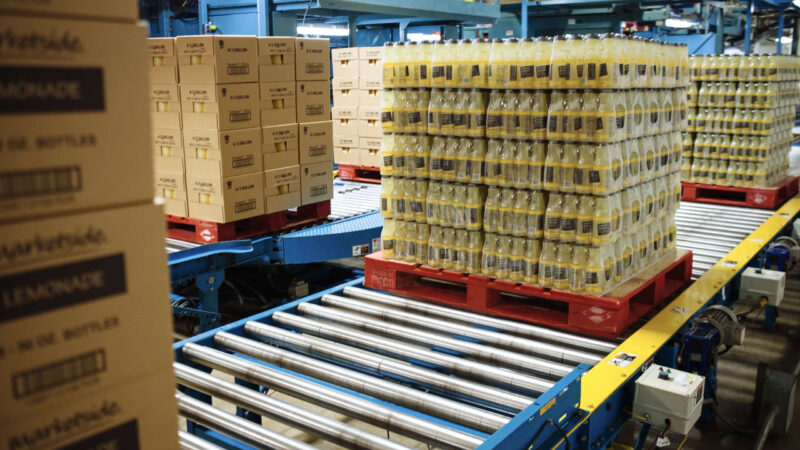
Heavy-duty pallet conveyors utilize powered transport lines to establish controlled buffers for industrial loads.
The conveyor is divided into zones that allow individual loads to stop and wait until space becomes available downstream.
The principle is similar to zero-pressure accumulation used for cartons and totes. Sensors detect the presence of a load and communicate with adjacent zones. If the next zone is occupied, the approaching load stops. When space becomes available, the conveyor releases the load and allows it to continue.
For heavier products, chain-driven live roller conveyor is often a good fit because chains and sprockets provide the positive drive needed to move substantial loads. When combined with zone controls, the conveyor can move, stop, and accumulate individual pallets without allowing them to push against one another.
That distinction is important. Simply adding conveyor length provides somewhere for pallets to sit. A true accumulation system controls when each load moves, where it stops, and when it can advance.
Heavier loads require more than a stronger conveyor.
Load capacity is an obvious consideration, but selecting a conveyor capable of supporting the weight is just the beginning.
A heavy load creates additional forces every time it starts and stops. Pallet construction and condition affect how the load travels across the rollers. The product’s center of gravity can affect stability. Curves and transfers change the way the load moves through the system, while inclines and declines present additional challenges that must be considered during design.
Zone length also has to match the product. Each accumulation zone needs enough space to contain the load and maintain the separation required by the system. The design also needs to account for how loads enter and leave the conveyor, whether that involves a forklift, palletizer, stretch wrapper, robot, or another conveyor.
The amount of accumulation should come from the operation itself. A manufacturing line may need enough buffer to continue producing while a stretch wrapper completes a cycle. A palletizer may need somewhere to send a finished load while a forklift removes the previous one. Production may also send material toward a warehouse faster than the warehouse can receive it for short periods.
In each case, the goal is not simply to add conveyor. The goal is to provide enough controlled buffer to keep a normal interruption in one part of the operation from immediately affecting another.
Case Study: Controlling 4000 lb pallet loads accumulating across 335 feet.
Dive into this Technimark case study for a practical look at why heavy-duty pallet conveyor requires complete application analysis. This project highlights how real-world engineering successfully resolves complex incline and momentum challenges without unnecessary system complexity.
Read the case study: Advanced Pallet Conveyor Solution for Manufacturing Tunnel
When frequent downtime forced Technimark, a global leader in turnkey injection molding, to truck finished goods between facilities, AEC replaced an aging legacy setup with a robust 335-foot chain-driven live roller system.
Featuring 67 independent zoned accumulation areas, the installation overcomes a tricky three-degree decline using double gear reduction to reliably control 4,000-pound loads. This streamlined approach successfully eliminates complex PLCs and pneumatics, proving that heavy-duty material handling thrives on smart application design rather than unnecessary mechanical overhead.
AEC expert perspective: Application details drive the design.
“With heavy-duty accumulation, knowing the weight is only the beginning. We need to know what the load looks like, how it’s supported, and which direction the pallet’s bottom boards run. We also need to understand whether loads enter and exit from the side or the end, where they need to stop, and what happens before and after the conveyor. Two pallets that weigh exactly the same can require two very different solutions,” states Brad Pearson, Engineer & Material Handling Specialist
That is precisely why the conversation should start with the application rather than a conveyor model. Load weight matters, but pallet construction, stability, orientation, available space, required accumulation, and the equipment around the conveyor can be just as important to the final design.
Get Started: Finding the right heavy-duty accumulation system
Heavy-duty accumulation applies the same basic principle used throughout accumulation conveyor systems to much larger loads. When the next process cannot immediately accept a pallet or industrial load, the conveyor provides controlled space for that product to wait without unnecessarily stopping the rest of the operation.
At AEC, we believe every conveyor system should be designed around the application, not the technology. The right solution depends on the product being conveyed and the goals of the operation. That’s why we take the time to understand each application before recommending a conveyor system.
Whether the load weighs 20 pounds or 4,000 pounds, the objective remains the same: control the product, support the process, and keep the operation moving. Connect with a conveyor specialist today to discuss your load requirements, workflow goals, and layout challenges.
Pallet Conveyor FAQs
How much weight can an accumulation conveyor handle?
Heavy-duty accumulation conveyors can handle loads weighing several thousand pounds, depending on the equipment and application. For example, Hytrol’s 36-CREZD chain-driven live roller accumulation conveyor is rated for loads up to 5,000 pounds per zone, while Hytrol’s heavy-duty drag chain conveyor systems offer capacities up to 6,000 pounds. The appropriate capacity depends on the conveyor design, how the load is supported, and the requirements of the operation. AEC’s Technimark project demonstrates this capability in practice, with a system designed to accumulate loads weighing up to 4,000 pounds.
How much accumulation does an operation need?
The amount of accumulation needed depends on how long products may have to wait before moving to the next part of the operation. An operation may need enough accumulation to accommodate a stretch-wrapper cycle, forklift pickup, palletizer output, warehouse delay, or another downstream process. Designing around the actual process helps avoid paying for unnecessary conveyor while still providing enough buffer to protect production.
Can heavy-duty accumulation be added to an existing operation?
Yes, when the existing layout and surrounding equipment allow it. Projects involving existing facilities often require the new conveyor to work within established elevations, footprints, transfers, and production requirements. Careful planning can make it possible to upgrade an existing operation while minimizing disruption to production.
Partnering with AEC
Since 1960, AEC has remained the leading conveyor integrator in North and South Carolina, and delivering elite material handling expertise to the entire US.
AEC’s premier status is built on a “boots on the ground” approach that transforms complex material handling challenges into streamlined, high-performance realities. By combining local expertise in the Carolinas with a robust nationwide reach, we provide the scalability of a national firm with the dedicated, responsive service of a regional partner.
Written by AEC Director of Customer Engagement, Josh Hamrick