
Estimated reading time: 5 minutes
Not every sortation challenge comes down to moving bigger cartons faster.
In many operations, the real difficulty appears when the product mix shifts toward smaller, lighter, and more flexible items, especially within an automation sortation conveyor strategy built to support modern fulfillment demands. Polybags, soft goods, and compact packaged products place very different requirements on a system when order volume is high and accuracy is non-negotiable. These conditions demand a level of control that traditional sortation conveyors do not always handle effectively.
A split-tray sorter conveyor is designed for exactly this type of application. Instead of relying on surface friction or lateral pushing, it manages each product independently using individual trays. This approach makes split-tray systems especially effective in high-volume eCommerce operations and facilities handling small and lightweight packages, where accuracy, density, and consistency drive overall performance.
Executive Summary: Split-tray sortation conveyors provide precise, high throughput sorting for eCommerce and small package distribution. By carrying each item on an individual tray and discharging vertically, these systems deliver reliable single-item control, compact layouts, and predictable product flow in demanding fulfillment environments. AEC designs and integrates split-tray systems to align throughput goals, product profiles, and facility constraints for long term operational performance.
- How split-tray sorter conveyors work.
- Core advantages of split-tray sorter systems.
- Best use cases for split-tray sorters.
- Split-tray versus other sortation technologies.
- What to assess before investing in a split-tray sortation system.
- Best practices for implementing split-tray sortation systems.
- Take the first step to a smarter, more scalable sortation strategy.
How split-tray sorter conveyors work.
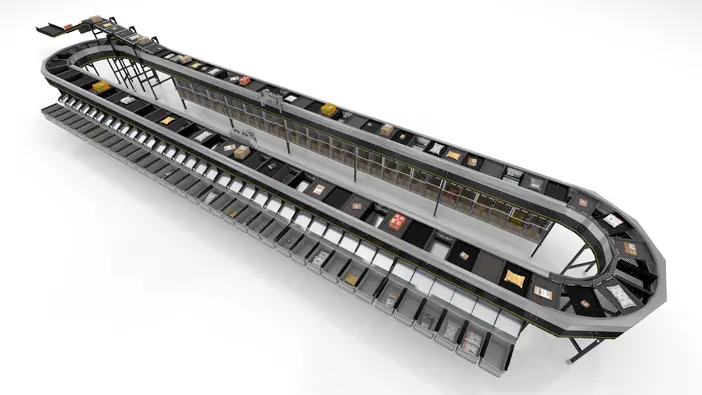
A split-tray sorter is a tray-based sortation conveyor built around a continuous loop of individual trays. Each tray consists of two panels that remain closed while carrying a product through the system. At the assigned discharge location, the panels open, allowing the item to drop vertically into a chute, bin, or tote below.
Products are loaded onto trays at induction stations, where scanners identify each item and assign it a destination. As trays circulate, the control system tracks their position with precision. When a tray reaches the correct divert point, the system triggers the opening mechanism, releases the product, and then closes the tray before it continues around the loop.
Because each product rides alone on its own tray, the system maintains consistent spacing and eliminates interference between items. This single-item control is a defining characteristic of split-tray sortation technology.
Core advantages of split-tray sorter systems.
Split-tray sorter systems are engineered for operations that demand speed, precision, and consistent handling of high volume, small package flows. Their design supports accurate single item control, efficient use of space, and predictable product movement, making them a strong solution for modern eCommerce and high throughput fulfillment environments.
-
High throughput performance designed to support peak e-commerce demand
-
Single-item sorting accuracy through isolated tray handling
-
Compact system layouts enabled by vertical discharge
-
Stable handling for small and lightweight packages
-
Predictable product flow that supports consistent downstream processes
Best use cases for split-tray sorters.
Operations that manage high volumes of small packages and complex order profiles benefit significantly from tray based sortation approach. The system excels in environments that demand consistent single item routing, gentle handling of lightweight goods, and the flexibility to support multiple fulfillment channels without sacrificing throughput or accuracy.
-
E-commerce fulfillment operations handling high volumes of small packages
-
Facilities sorting soft goods and lightweight packaged items
-
Returns processing environments with inconsistent inbound packaging
-
Omnichannel distribution centers supporting direct-to-consumer and store replenishment
-
High-volume operations requiring repeatable, single-item routing
Split-tray versus other sortation technologies.
Split-tray sorters are one option within a broader range of sortation conveyor solutions. Understanding where they fit helps guide technology selection.
Split-Tray vs Sliding Shoe Sortation: Sliding shoe sorters are well suited for cartons and totes moving across a flat surface at high speed. They are less effective for lightweight or flexible items that may not respond predictably to surface-based diverts.
Split-Tray vs Crossbelt Sortation: Crossbelt sorters provide flexible handling for a wide range of packaging types and perform well in parcel and mixed SKU environments. Split-tray systems outperform crossbelt technology when destination density is high and vertical discharge into bins or totes is required.
Split-Tray vs Tilt-Tray Sortation: Tilt-tray and split-tray systems share similar tray-based principles. Split-tray designs are often preferred when small and lightweight items require precise vertical release rather than angled discharge.
What to assess before investing in a split-tray sortation system.
Before committing to a new sortation platform, it is essential to evaluate how well the system aligns with both current operations and future growth plans. A thoughtful assessment of product characteristics, performance expectations, facility constraints, and long term service requirements helps ensure the investment delivers reliable performance and lasting operational value.
-
Product size, weight, and flexibility
-
Throughput requirements and peak volume expectations
-
Available vertical clearance
-
Number of required destinations
-
Induction and loading workflows
-
Integration with upstream and downstream conveyors
-
Long-term maintenance access and service planning
Best practices for implementing and maintaining split-tray sortation systems.
Induction station design has a direct impact on system performance. Products should be placed securely on trays with consistent orientation to maintain accuracy and flow. Well-designed loading workflows help reduce operator fatigue while supporting steady throughput.
Tray maintenance and access should be considered during system layout. Regular inspection of trays, hinges, and drive components supports long-term reliability and minimizes unplanned downtime.
Operator training and startup planning are equally important. Clear procedures for induction, monitoring, and recovery help ensure a smooth launch and sustained system performance.
Plan a sortation strategy that supports consistent performance and future expansion.
A split-tray sorter conveyor provides a precise and efficient solution for high-throughput sorting of small and lightweight packages. Its tray-based design supports single-item accuracy, compact layouts, and predictable routing in demanding e-commerce environments.
For operations focused on high-volume order fulfillment and small-package sortation, split-tray systems play an important role in modern automation strategies. AEC helps evaluate, design, and integrate these systems to ensure they deliver measurable operational value.
Talk with a conveyor automation specialist about designing a sortation system that meets today’s demands and delivers consistent performance as your operation evolves.
Why partner with AEC?
For over 65 years of providing conveyor solutions, AEC continues to be the leading sortation conveyor integrator in North and South Carolina.
AEC designs and integrates sortation conveyor systems using proven split-tray technology from Interroll. By aligning product flow, throughput requirements, and facility constraints, AEC delivers sortation solutions that support accuracy, scalability, and long-term operational stability
Written by AEC Director of Customer Engagement, Josh Hamrick