
Estimated reading time: 5 minutes
Designing sortation systems around flow, flexibility, and product integrity.
When facilities evaluate automated sortation conveyor options, speed often gets the most attention. But for many operations, the better question is how much speed is actually needed, and what is sacrificed to get it. Noise levels, energy use, maintenance demands, and long-term reliability all factor into that decision. In these situations, narrow belt sorters often emerge as a practical middle ground, delivering accurate, repeatable sorting without the complexity of high-speed systems.
A narrow belt sorter conveyor is designed for environments where control, consistency, and efficiency matter more than peak throughput. By combining precise divert control with quiet operation and low energy consumption, narrow belt systems provide dependable performance for a wide range of distribution applications.
Executive Summary: Narrow belt sorter conveyors provide accurate, controlled sortation for medium-throughput operations, addressing flow, space, and reliability challenges without the complexity of high-speed systems. Using multiple narrow belts and precise transfer control, they divert and route products smoothly while reducing noise, energy use, and maintenance. Narrow belt sortation is ideal for distribution environments that require consistent performance, flexible layouts, and long-term operational efficiency.
- What is a narrow belt sorter?
- How do narrow belt sorters work?
- Core advantages of narrow belt sortation systems?
- Best use cases for narrow belt applications?
- Narrow belt sorters compared to other sortation technologies.
- What to assess before choosing narrow belt sorter.
- Implementation tips and best practices for narrow belt sortation.
- Get started with sortation solutions.
What is a narrow belt sorter?
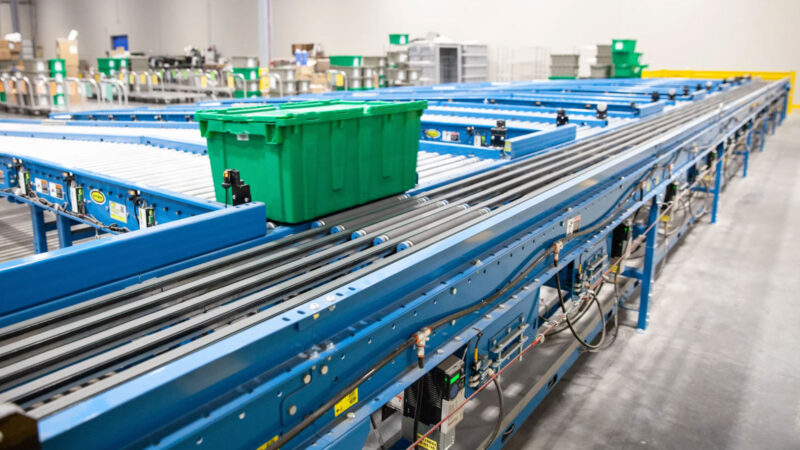
A narrow belt sorter uses multiple narrow conveyor belts running in parallel. Between these belts are high-friction divert wheels that rise when activated. When a divert is required, the wheels lift between the belts and guide the product to a takeaway conveyor at a defined angle, commonly 30 degrees or 90 degrees.
When the divert is complete, the wheels retract and the product continues straight ahead. This design allows products to remain supported throughout the process while still providing accurate and repeatable sorting.
How do narrow belt sorters work?
Products travel on the narrow belts under normal operation. As an item approaches its assigned divert point, sensors signal the divert wheels to rise. The wheels contact the bottom of the product and gently guide it toward the correct lane.
Because the belts continue moving while the wheels engage, the product maintains forward motion and stability. This controlled interaction helps reduce bouncing or hesitation, especially with cartons and totes that have uneven weight distribution.
Core advantages of narrow belt sortation systems?
Narrow belt sorters offer several advantages for medium-throughput applications.
- Quiet operation – Electric divert wheels and belt-driven motion result in lower noise levels compared to chain-driven systems.
- Energy efficiency – Divert wheels activate only when needed, reducing overall power consumption.
- Consistent divert accuracy – Products remain fully supported, improving repeatability across multiple lanes.
- Compact and modular design – Narrow belt sections are easy to integrate into existing conveyor layouts.
- Lower maintenance requirements – Fewer mechanical components compared to pushers or chain-driven diverters.
Best use cases for narrow belt applications?
Narrow belt sortation systems are commonly used where throughput demands are moderate and reliability is critical.
- Distribution centers handling cartons and totes
- Facilities requiring quiet conveyor operation
- Sortation zones feeding packing or shipping areas
- Operations with frequent lane changes or reconfiguration needs
- Warehouses focused on reducing energy use and maintenance
Narrow belt sorters compared to other sortation technologies.
Narrow belt sorters fill a different role than high-speed sortation systems.
Compared to sliding shoe or crossbelt sorters, narrow belt systems operate at lower speeds but require less space and system complexity. They are not intended for large numbers of destinations or extremely high throughput.
Compared to pop-up wheel sorters, narrow belt systems provide more consistent support and smoother diverts, especially for cartons with uneven bottoms or shifting contents.
Compared to ARB systems, narrow belt sorters focus on defined divert points rather than continuous flow manipulation or product rotation.
What to assess before choosing narrow belt sorter.
Before selecting a narrow belt sorter conveyor, facilities should evaluate:
- Product size, weight, and bottom surface condition
- Required divert angles and lane spacing
- Desired operating speed and throughput
- Noise level expectations
- Integration with upstream and downstream conveyors
- Maintenance access and spare parts strategy
Understanding these factors helps ensure the system aligns with operational goals and future growth.
Implementation tips and best practices for narrow belt sortation.
Proper spacing between diverts is important for smooth operation. Products should have adequate gap to allow wheels to engage cleanly without interference.
Divert wheel timing should be tuned to the product mix. Lightweight cartons may require different settings than heavier totes to maintain consistent tracking.
Routine inspection of belts and divert wheels helps maintain performance and prevent uneven wear.
Efficient narrow belt sorters that keep operations running smoothly.
A narrow belt sorter conveyor provides a dependable solution for medium-throughput sortation where quiet operation, energy efficiency, and consistent performance are priorities. Its simple, modular design makes it easy to integrate and maintain over time.
For distribution centers seeking reliable sorting without the cost and complexity of high-speed systems, narrow belt sorters remain a practical and effective option. AEC helps design and implement these systems to support long-term operational success.
Talk with a conveyor sortation specialist about narrow belt sorter solutions that provide dependable control now and flexibility as your operation grows.
Partnering with AEC
For over 65 years of providing conveyor solutions, AEC continues to be the leading sortation conveyor integrator in North and South Carolina.
AEC designs and integrates narrow belt sortation systems using Hytrol’s ProSort MRT model. By focusing on how products move through each divert point, AEC applies narrow belt sortation where it makes the most sense within the overall conveyor layout. This approach ensures the system delivers consistent performance, integrates cleanly with upstream and downstream equipment, and supports long-term reliability without unnecessary complexity.
Written by AEC Director of Customer Engagement, Josh Hamrick