
Estimated reading time: 5 minutes
High-flexibility sortation for tight spaces and gentle product handling.
Straight runs of conveyor rarely cause problems. It is when products need to change direction, feed multiple areas, or move through tight sections of a system that challenges start to show up. It’s not always practical to add length or complex divert equipment in these areas. Pivot wheel sorters are built for exactly those situations, serving as a versatile sortation conveyor solution.
A pivot wheel sorter conveyor is designed to redirect products smoothly within a conveyor line without relying on pushers or lift mechanisms. By guiding items onto alternate paths using powered wheels, pivot wheel sorters provide a practical way to add routing flexibility while keeping layouts compact and manageable.
Executive Summary: Pivot wheel sorters provide a high-flexibility, compact solution for routing products in tight layouts. By using motorized, multidirectional wheels, these systems ensure smooth, low-impact diverts for cartons and totes without the footprint of high-speed sorters. They offer a reliable, scalable way to optimize modern sortation.
- What is a pivot wheel sorter?
- How do pivot wheel sorters work?
- Why choose pivot wheel sortation?
- What are the optimal best-use cases?
- How do pivot wheels compare to other sortation technology?
- What should you assess before choosing a pivot wheel sorter?
- What are the implementation best practices?
- Get started with sortation solutions
System Components: What is a pivot wheel sorter?
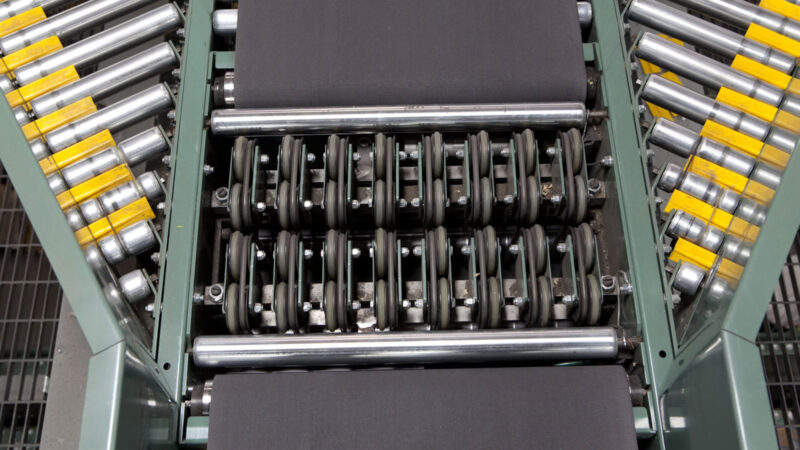
A pivot wheel sorter consists of a series of motorized, multidirectional wheels integrated directly into the conveyor surface. Each wheel can pivot to change its angle relative to the direction of product flow. When activated, the wheels guide a product onto a divert lane while maintaining continuous forward movement.
When no divert is required, the wheels remain aligned with the main conveyor, allowing products to pass straight through. This design supports multiple routing options without adding separate mechanical diverts or increasing conveyor length.
Operational Mechanics: How do pivot wheel sorters work?
Pivot sorters operate by using sensors to trigger precise wheel rotation at the exact moment a product reaches a divert zone. As the wheels rotate, they guide the product toward the selected lane in a controlled and predictable manner.
Because the wheels remain in contact with the bottom of the product throughout the divert, movement is smooth and consistent. This approach helps maintain stability with cartons and totes and reduces the likelihood of tipping or product disruption.
Once the product clears the divert zone, the wheels return to their neutral position and are ready for the next routing decision.
Strategic Benefits: Why choose pivot wheel sortation?
Pivot wheel sortation is the ideal choice for operations that require multi-directional routing within a very small footprint. These systems offer several specific benefits for applications that require flexible routing within limited space.
- Multiple divert angles
Products can be routed to different lanes without dedicated mechanical diverters. - Compact footprint
Pivot wheel zones fit into tight conveyor layouts where space is limited. - Smooth product handling
Items are guided rather than pushed, reducing impact and product disturbance. - Fast routing response
Wheel actuation allows quick routing decisions without stopping product flow. - Simple integration
Pivot wheel modules integrate easily into existing conveyor systems.
Facility application: What are the optimal best-use cases?
The best-use cases for pivot wheel sorters involve distribution centers and manufacturing plants where floor space is at a premium and product handling must remain low-impact. This technology is commonly applied where routing flexibility and layout efficiency are priorities.
- Distribution centers with limited floor space
- Sortation zones feeding multiple packing or processing areas
- Systems requiring frequent lane changes or reconfiguration
- Carton and tote handling operations
- Workflows that benefit from controlled, low-impact diverts
Side-by-Side: How do pivot wheels compare to other sortation technologies?
Pivot wheel sorters distinguish themselves from other technologies by offering a middle ground between simple push-diverts and high-speed, high-cost sortation systems. They fill a unique role compared to tray-based or belt systems:
- Vs. Narrow belt sorters: Pivot wheel systems provide greater routing flexibility within a smaller footprint but typically operate at lower throughput rates.
- Vs. ARB systems: Pivot wheel sorters use defined divert points rather than continuous lateral movement across a belt surface.
- Vs. Push diverters: Pivot wheel systems reduce product impact and allow smoother transitions into takeaway conveyors.
Selection Criteria: What should you assess before choosing a pivot wheel sorter?
To determine if a pivot wheel sorter is right for your facility, you must first evaluate your specific product dimensions, required throughput, and existing space constraints. Specifically, facilities should assess:
- Product size, weight, and bottom surface condition
- Required divert angles and routing complexity
- Available conveyor length and space constraints
- Throughput requirements at each divert point
- Integration with upstream and downstream conveyors
- Control system responsiveness and sensor placement
Evaluating these factors helps ensure the sorter fits both operational needs and physical constraints.
Performance Optimization: What are the implementation best practices?
Successful implementation depends on perfecting the timing of wheel actuation and ensuring regular maintenance of the drive motors. Proper wheel spacing is critical for consistent routing. Products should be evenly spaced so wheels can engage cleanly without interference.
Divert angles should be selected based on product stability and takeaway conveyor speed. Testing during commissioning helps fine-tune performance. Routine inspection of wheels and drive motors supports long-term reliability, especially in high-traffic divert zones.
Integration Expertise: How can you get started with AEC?
AEC specializes in the design and integration of pivot wheel sortation systems, specifically utilizing proven models like the Hytrol ProSort SC. By focusing on routing logic, space constraints, and downstream flow, AEC ensures pivot wheel sorters are applied where flexibility and control provide the greatest benefit.
Get in touch with a conveyor specialist for sortation solutions that deliver dependable control today and the layout flexibility to scale with your operation tomorrow.
Partnering with AEC ensures maximum operational efficiency.
Over 65 years of providing conveyor solutions, AEC continues to be the leading sortation conveyor integrator in North and South Carolina.
AEC’s premier status is built on a “boots on the ground” approach that transforms complex material handling challenges into streamlined, high-performance realities. By combining local expertise in the Carolinas with a robust nationwide reach, we provide the scalability of a national firm with the dedicated, responsive service of a regional partner.
Our deep-rooted relationship with industry leaders like Hytrol allows us to deliver cutting-edge technology with precision-engineered integration that accounts for every inch of your facility’s footprint. Whether you are optimizing a local warehouse or a massive national distribution network, AEC delivers the engineering depth and legacy of reliability required to keep your throughput moving at peak capacity.
Written by AEC Director of Customer Engagement, Josh Hamrick