
Estimated reading time: 7 minutes
Optimizing throughput with “zero” product contact.
Operations today are expected to move more product with fewer interruptions. At the same time, packaging has become lighter, more varied, and often more fragile than it was in the past. To handle these fragile variations without losing throughput when downstream lines slow down, operations depend on advanced accumulation conveyor technology.
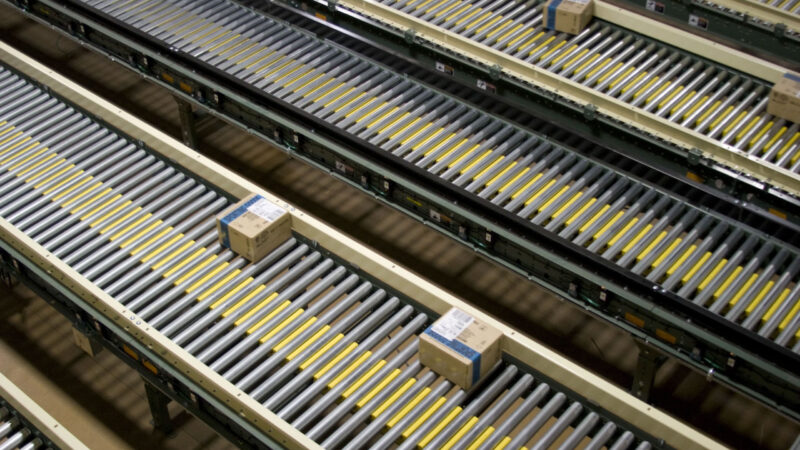
This is where Zero-Pressure Accumulation (ZPA) becomes important. Zero-Pressure Accumulation is designed to keep products separated while they move and queue on a conveyor. Instead of allowing cartons or pallets to make contact, the system creates controlled zones that stop products before they touch. In many facilities, this approach has become the standard for maintaining consistent flow while protecting product integrity.
Executive Summary: Zero-Pressure Accumulation (ZPA) conveyor technology optimizes throughput by eliminating back-pressure. Using sensor-controlled zones to prevent product contact, this system protects fragile packaging and ensures predictable flow. As a leading expert in advanced accumulation systems, Advanced Equipment Company (AEC) integrates this technology to maximize material handling efficiency and reliability.
- What is Zero-Pressure Accumulation?
- How do sensor-controlled zones prevent product contact?
- Why zero-pressure accumulation matters for product protection.
- Zero-Pressure vs. Minimum-Pressure Accumulation
- Energy savings through zone-based control.
- Drive types used in Zero-Pressure Accumulation.
- Why ZPA conveyor technology is the modern standard for line stability.
- Get started with the right accumulation strategy.
What is Zero-Pressure Accumulation?
Zero-Pressure Accumulation is designed to keep products separated while they move and collect on a conveyor.
The conveyor is divided into individual zones. Each zone monitors whether product is present and whether the downstream zone is available. If the next zone is occupied, the product stops and waits until space becomes available.
This creates controlled spacing throughout the system. Unlike Minimum-Pressure Accumulation, where products maintain light contact during queuing, zero-pressure accumulation ensures zero product-to-product contact by keeping every item completely separated. This eliminates back-pressure between products and greatly reduces crushing, scuffing, or product instability.
The result is smoother flow and better control during normal operation as well as during downstream interruptions.
How do sensor-controlled zones prevent product contact?
The foundation of Zero-Pressure Accumulation is zone control. Each accumulation zone uses sensors to detect when product enters or leaves a section of conveyor. Once a downstream zone becomes occupied, the upstream zone stops moving until space becomes available again.
This process happens continuously throughout the system. In many applications, photo-eyes are used to monitor product location and maintain spacing between cartons. The controls communicate between zones so products release in sequence without making contact.
The important part is not just stopping product, but stopping it in a controlled and repeatable way. When the line begins moving again, products release one zone at a time instead of surging forward all at once, which keeps flow organized and prevents the line from becoming unstable during recovery.
Why Zero-Pressure Accumulation matters for product protection.
One of the biggest advantages of Zero-Pressure Accumulation is product protection. In systems where products are allowed to touch, pressure builds as more cartons arrive from upstream. Over time, that force can crush corners, damage labels, or create instability in the load.
Zero-Pressure Accumulation prevents product damage from happening by maintaining separation between products. This becomes especially important in operations handling:
- Mixed-size cartons
- Lightweight packaging
- Electronics
- Pharmaceutical products
- Fragile consumer goods
- Unstable pallet loads
The more variation there is in the product stream, the more valuable controlled accumulation becomes.
In many operations, preventing product damage is only part of the benefit. Zero-Pressure Accumulation also improves how the line behaves overall. Products stay aligned more consistently, flow remains more predictable, and operators spend less time correcting jams or misaligned loads.
Zero-Pressure vs. Minimum-Pressure Accumulation
Both zero-pressure and minimum-pressure accumulation are designed to create buffer on the conveyor, but they manage product differently.
Minimum Pressure Accumulation:
Minimum-Pressure allows light contact between products while they queue. The system relies on controlled slip in the drive mechanism to limit the amount of force applied between items. Minimum-pressure systems can work well for uniform cartons and less sensitive products.
Zero-Pressure Accumulation:
Zero-Pressure technology completely eliminates product-to-product contact by utilizing isolated zones that ensure no two items ever meet on the line. With back-pressure entirely removed from the equation, operations gain the advanced protection and precise control necessary for handling fragile, mixed-size loads.
The difference becomes more noticeable as throughput increases. In higher volume systems, even small interruptions can create significant pressure buildup if products are allowed to make contact.
Energy savings through zone-based control.
Zero-Pressure Accumulation also improves energy efficiency. Instead of running continuously, many systems only power zones when product is present and movement is required. When a zone becomes occupied, that section stops until the downstream path clears. This reduces unnecessary roller movement and lowers wear on components.
Motor-Driven Roller (MDR) systems are especially effective in this area because they utilize low-voltage, independently controlled zones rather than a single, continuous drive. Depending on the design, the motor can be built directly into the individual roller, or external. Both approaches allow accumulation zones to operate completely independently, running only when product is present and stopping items precisely before contact occurs. This significantly reduces overall energy consumption while extending equipment life.
In facilities running multiple shifts, these energy efficiency gains can become significant over time.
Drive types used in Zero-Pressure Accumulation.
Several different drive methods can be used to achieve zero pressure technology. The right drive type depends on the product, throughput requirements, and the level of control needed within the system:
Motor-Driven Systems:
Use controlled zones powered by low voltage motors. In some designs, the motor is built directly into the roller. In others, such as the Hytrol E24 platform, a compact motor powers a section of rollers through O-rings. Both approaches allow zones to operate independently and stop product before contact occurs.
Belt-Driven Systems:
In these applications, pneumatic or mechanical controls engage and disengage individual zones based on product location.
Chain-Driven Systems:
Typically used in heavier applications such as pallet handling. These systems provide the positive drive required for larger loads while still maintaining controlled spacing between products.
Common applications for Zero-Pressure Accumulation.
When maintaining flow and protecting products are both critical, ZPA systems are widely used.
Common applications include:
- E-commerce fulfillment
- Distribution centers
- Pharmaceutical handling
- Electronics manufacturing
- Packaging lines
- Small parcel handling
- Heavy-duty pallet accumulation
Accumulation systems are especially valuable where downstream equipment operates at varying speeds or where interruptions occur regularly. In many facilities, Zero-Pressure Accumulation acts as the buffer that keeps the rest of the operation stable.
Why ZPA conveyor technology is the modern standard for line stability.
As conveyor systems have become more automated, expectations for control and reliability have increased. Operations no longer want product simply moving from one point to another. They need systems that can manage variation, recover quickly from interruptions, and protect products throughout the process.
Zero-Pressure Accumulation helps accomplish all of those goals. By maintaining separation between products and controlling how the line responds during a slowdown, these systems create more stable conveyor flow overall. Products move more predictably, interruptions are easier to recover from, and the line stays organized even during higher throughput conditions.
That consistency is one of the biggest reasons ZPA technology has become so common in modern conveyor systems. In many operations, the improvement is not just about running faster. It is about reducing the small disruptions that create larger problems throughout the day.
Get started with AEC: Choosing the right accumulation strategy for your operation.
AEC is the premier integration partner for advanced automation and conveyor technology. We engineer Zero-Pressure Accumulation systems that handle your most complex architectural layouts, high-volume surges, and fragile packaging types without sacrificing throughput.
If your facility is battling recurring bottlenecks, product damage, or erratic line flow, contact a conveyor specialist today to stabilize your material handling system and protect your bottom line.
Partnering with AEC
Since 1960, AEC has remained the leading conveyor integrator in North and South Carolina, and delivering elite material handling expertise to the entire US.
AEC’s premier status is built on a “boots on the ground” approach that transforms complex material handling challenges into streamlined, high-performance realities. By combining local expertise in the Carolinas with a robust nationwide reach, we provide the scalability of a national firm with the dedicated, responsive service of a regional partner.
Written by AEC Director of Customer Engagement, Josh Hamrick