
Estimated reading time: 8 minutes
Efficiently moving palletized goods has long been a pain point for warehouses and production floors.
Forklifts navigating tight aisles introduce safety risks, manual handling drags down throughput, and staging areas quickly become bottlenecks as heavy loads stack up. Factor in rising labor costs, constant equipment strain, and the unrelenting demand for faster order fulfillment, and it’s easy to see why traditional pallet handling methods can’t keep up with modern operations.
That’s where modern pallet handling conveyors step in – not as a luxury, but as a core element of warehouse automation. By moving beyond outdated, labor-heavy methods, they create the foundation for safer, faster, and more scalable operations. Integrated with robotics, AI-driven systems, and Industry 4.0 technologies, these conveyors are not just keeping pace with today’s demands – they are positioning warehouses to adapt and thrive in the automation-driven future of material handling.
- What Is a Pallet Handling Conveyor System?
- Benefits of pallet conveyors in warehouse and manufacturing operations.
- How pallet handling conveyor connects to robotics and scalable automation.
- Where are pallet handling conveyors commonly used?
- What types of pallet conveyors are used for industrial applications?
- How to choose the right pallet conveyor system for your operation.
- Safety and maintenance best practices for pallet conveyors.
- Why pallet conveyor systems are essential for modern applications.
- Get Started with AEC Pallet Handling Experts
What is a Pallet Handling Conveyor System?
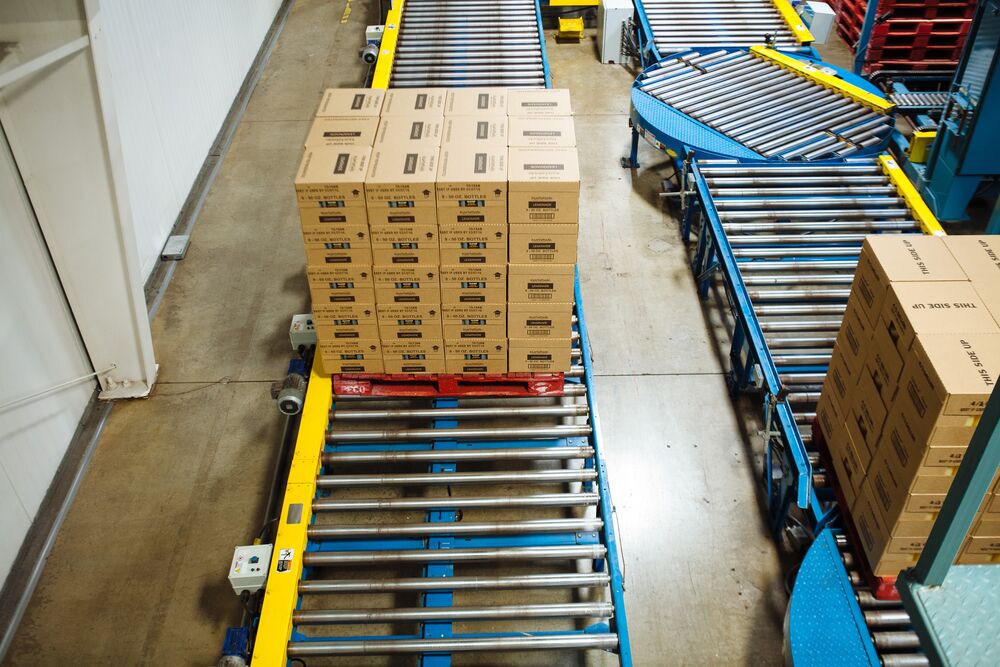
A pallet handling conveyor system is designed to transport heavy, bulky pallet loads made of wood, plastic, or custom materials through a facility with minimal manual handling.
Instead of relying on forklifts for every move, these systems use powered roller conveyors, chain drives, or a combination of both to move loads along a set path.
They can send pallets straight through production, rotate them for labeling or inspection, accumulate them in staging areas, or transfer them between conveyor lines without manual lifting.
Integrated with palletizers, stretch wrappers, robotic cells, and automated pallet movement systems, they form the backbone of a warehouse pallet transport solution that is both efficient and scalable.
Project Spotlight:
Improved Pallet Flow for Major Packaging Provider by Trace Davis
Integrated Pallet Handling Conveyor System for Extra Heavy Product by Darin Boik
Benefits of pallet conveyors in warehouse and manufacturing operations.
- Efficiency Gains – A pallet roller conveyor keeps heavy loads moving without forklift delays, reducing bottlenecks.
- Improved Safety – Reduces forklift traffic, lowering collision and injury risks.
- Product Protection – Smooth, consistent movement reduces product damage compared to rough manual handling.
- Labor Savings – Frees employees from repetitive transport tasks.
- Scalability – A custom pallet conveyor layout design can adapt to growth and changing workflows.
- Automation-Ready – Pallet conveyors integrate seamlessly with robotic palletizers, AGVs, and AS/RS systems, making them a foundational step toward full warehouse automation.
How pallet handling conveyor connects to robotics and scalable automation.
Pallet handling conveyors are no longer limited to simple transport from point A to point B. In their most basic form, they eliminate manual lifting by moving pallets safely along a fixed path. But modern warehouses are taking these systems much further – integrating them with automation and robotics to handle everything from labeling and stretch wrapping to order sequencing and shipping.
At the intermediate level, conveyors work alongside robotic palletizers, depalletizers, and automated guided vehicles (AGVs) to streamline repetitive handling tasks. These integrations reduce dependency on forklifts, cut labor costs, and improve safety while maintaining consistent throughput.
On the advanced end, pallet conveyors serve as the backbone of fully automated material handling environments, linking production cells, robotic workstations, and automated storage and retrieval systems (AS/RS). AI-driven controls and smart sensors allow for real-time adjustments, predictive maintenance, and data-driven optimization of the entire flow.
The result is scalability. Facilities can start small – automating just a few key points of movement – and expand to a fully automated system as volume grows. This modular approach ensures that pallet handling conveyors evolve with the business, providing a future-ready foundation for modern warehouse automation.
Where are pallet handling conveyors commonly used?
- Food and Beverage facilities – Move bulk ingredients, packaged goods, and outbound pallets.
- Automotive and Heavy Equipment plants – Handle engines, transmissions, and large assemblies.
- Distribution & Fulfillment Centers – Stage and sort orders for shipment.
- Manufacturing Plants – Integrate with assembly lines and automated storage/retrieval systems (AS/RS).
- Cold Storage facilities – Transport goods in refrigerated or freezer environments.
Example: An automotive plant might use a heavy-duty roller conveyor to transport subassemblies between workstations, while a cold storage facility may use a drag chain conveyor with corrosion-resistant components.
What types of pallet conveyors are used for industrial applications?
Selecting the right system depends on load weight, size, pallet material, and throughput requirements.
- Chain-Driven Live Roller (CDLR) Conveyors – Heavy-Duty and Reliable
A chain-driven live roller conveyor uses a chain drive to power each roller, delivering consistent motion for heavy or uneven pallet loads. CDLR is the workhorse of heavy-duty conveyor systems for pallets. - Drag Chain Conveyors – Ideal for Pallet Orientation and Stability
A drag chain conveyor system moves pallets on two or more parallel strands of chain, ensuring stability for non-standard or damaged pallets. They are excellent for dirty or debris-prone environments. - Roller Transfer Conveyors – Efficient Pallet Transfers Between Lines
These allow pallets to be moved between parallel conveyor lines quickly, providing flexibility in complex pallet transfer systems. - Turntable Conveyors – Directional Change Without Lifting
A turntable conveyor for pallets rotates loads up to 360 degrees in tight spaces, enabling directional changes without a forklift. - Transfer Cars and Pallet Shuttles – High-Capacity Movement Across Zones
Ideal for large facilities, these move pallets between zones, supplementing or replacing long runs of conveyor. - Accumulation Conveyors for Pallets – Buffering Heavy Loads Safely
A pallet accumulation conveyor allows staged pallets to queue without pressure buildup, protecting goods and ensuring smooth product flow before palletizing or shipping.
How to choose the right pallet conveyor system for your operation.
A powered roller conveyor for pallets is not one-size-fits-all. Your choice should reflect your load profile, space limitations, and operational goals.
If your facility handles large, uniform pallet loads at high speeds, a CDLR system may be ideal. If your pallets vary in condition or size, a drag chain solution might be a better fit.
Key Design Considerations for Pallet Conveyor Systems:
- Load Weight and Dimensions – The heavy-duty conveyor system for pallets must handle your heaviest and widest loads.
- Pallet Type – Wood, plastic, and custom pallets require different roller spacing, chain pitch, or surface treatments.
- Speed and Throughput Requirements – Calculate how many pallets you must move per hour to size motors and controls correctly.
- Floor Space and Integration – A warehouse conveyor integration for pallet loads should work seamlessly with your current equipment.
- Environmental Conditions – Wet, cold, or dusty areas may require stainless steel or sealed components.
- Automation Level – Decide if you want fully automated pallet staging conveyors or semi-automated systems compatible with forklifts and pallet jacks.
Safety and maintenance best practices for pallet conveyors.
A well-maintained industrial conveyor equipment for pallet operations can last for decades.
- Guarding and Signage – Protects employees from moving parts.
- Operator Training – Ensures proper loading, unloading, and emergency stop use.
- Lubrication – Keeps chains, bearings, and drive systems running smoothly.
- Cleaning – Prevents jams and maintains system efficiency.
- Preventive Maintenance – Identifies wear before it causes downtime.
Why pallet conveyor systems are essential for modern applications.
In today’s fast-moving warehouse and manufacturing environments, an efficient pallet handling conveyor is more than just a tool – it is a competitive advantage. Modern systems go far beyond basic transport, serving as the backbone for automation strategies that improve throughput, enhance worker safety, and minimize product damage.
From simple accumulation conveyors that buffer heavy loads to fully automated systems integrated with robotics and AS/RS, the right pallet handling solution supports scalable growth.
Facilities can start with targeted automation where it delivers the most impact – then expand as demand increases – ensuring their investment grows with their business.
Get Started with AEC Pallet Handling Experts
As one of the most trusted pallet handling conveyor suppliers in North & South Carolina, AEC brings more than 65 years of experience to every project.
Advanced Equipment Company has decades of experience designing and installing custom pallet conveyor systems that align with these goals. Whether you need a straightforward staging solution or a fully automated material handling network, our team can engineer a system that positions your operation for long-term success in the automation-driven future of warehousing.
Contact a conveyor system expert today.
Written by AEC Director of Customer Engagement, Josh Hamrick.
Pallet Handling Conveyor FAQ
It’s a system that moves heavy palletized loads on rollers or chains, reducing manual handling and forklift use.
They’re common in warehouses, manufacturing plants, distribution centers, automotive facilities, and cold storage.
They keep pallets moving continuously, cut down on forklift traffic, and prevent costly bottlenecks.
Options include chain-driven live roller, drag chain, transfer conveyors, turntables, shuttles, and accumulation conveyors.
Key considerations include pallet weight, size, material, throughput needs, space, environment, and automation level. AEC handles full planning – all built for uptime and future growth.
They integrate seamlessly with robotic palletizers, AGVs, and AS/RS systems, making them automation-ready and scalable.
By reducing forklift interactions and manual lifting, they lower injury risks and protect both workers and products.
Regular lubrication, cleaning, operator training, and preventive maintenance keep systems running efficiently with less downtime.
For more than 65 years, AEC has been a trusted leader in designing and installing pallet conveyor systems – from straightforward layouts to fully automated, robotics-integrated solutions built to drive long-term performance.