
Estimated reading time: 6 minutes
Designing sortation systems around flow, flexibility, and product integrity.
A successful automation sortation conveyor strategy is not simply about moving products at maximum speed or feeding dozens of outbound lanes. In fact, in many facilities, the greater challenge is optimizing internal flow: merging product streams, diverting to workstations, rotating items for downstream processes, or routing products without impact. Each of these functions plays a direct role in throughput, accuracy, and overall system stability.
ARB and DARB sorters are purpose-built for these requirements. Instead of relying on pushers or external diverters, they use embedded rollers within the conveyor belt to move products laterally, rotate them, or redirect them smoothly within the flow of the system. This architecture makes ARB-based sortation especially effective for operations that demand flexibility, precise control, and gentle product handling across a broad range of product sizes, weights, and packaging types.
Executive Summary: ARB and DARB conveyor sorters provide precise control of product movement within the conveyor line, solving flow, handling, and routing challenges that high-speed sorters and mechanical diverters cannot. Using embedded motorized rollers, they divert, merge, rotate, and transfer products without impact, improving throughput, protecting product integrity, and reducing maintenance. ARB and DARB sortation is ideal for mixed products, complex layouts, and evolving operations.
- What are ARB and DARB sorters?
- How do ARB and DARB sorters work?
- What are core advantages of ARB and DARB sortation systems?
- When should ARB and DARB technology be used?
- ARB and DARB compared to other sortation technologies.
- What to assess before choosing and ARB or DARB system.
- Implementation tips and best practices for ARB and DARB systems.
- Get started with ARB or DARB today.
What are ARB and DARB sorters?
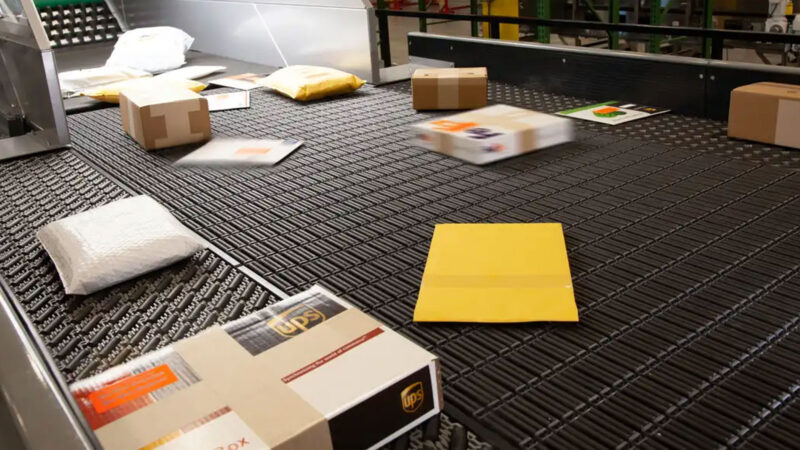
ARB stands for Activated Roller Belt. An ARB sorter uses a conveyor belt with angled rollers molded into the belt surface. When activated, those rollers move independently of the belt, allowing products to shift direction while remaining supported.
DARB, or Dual Activated Roller Belt, builds on the same concept but uses opposing roller angles to transfer products cleanly at 90 degrees. This allows for precise side transfers without lifting, pushing, or impacting the product.
Both technologies are commonly used as conveyor-based sorters within larger material handling systems rather than standalone high-speed sorters.
How do ARB and DARB sorters work?
ARB and DARB sorters use motorized rollers embedded directly into the conveyor belt to control product movement without disrupting the main flow of the system. Products travel on the belt surface like they would on a standard conveyor until a divert, merge, or transfer is required. At that point, the embedded rollers activate and begin turning, moving the product laterally while the belt itself continues its forward motion.
With ARB sorters, products can be diverted at shallow angles, merged smoothly into adjacent lanes, or rotated to change orientation for downstream processes. With DARB sorters, products transfer cleanly at a right angle to a perpendicular conveyor line.
Because the product remains fully supported throughout the entire movement, ARB and DARB systems significantly reduce sliding, tipping, and impact, even when handling irregularly shaped or unstable items.
What are core advantages of ARB and DARB sortation systems?
The core advantages of ARB and DARB technology are superior control, flexibility, and reliability compared to traditional pop-up wheels or pusher-based diverters. By directing product movement within the conveyor surface itself, these systems reduce mechanical constraints, minimize product damage, and simplify maintenance, resulting in a more adaptable, space-efficient solution that supports higher throughput and better product integrity.
- Contact-free product movement – Products are redirected using roller motion rather than mechanical impact.
- Exceptional flexibility – Systems can divert, merge, rotate, or align products using the same conveyor surface.
- Gentle handling – Ideal for packages that are unstable, lightweight, or difficult to push.
- Compact integration – ARB and DARB sorters fit directly into existing conveyor lines without large divert assemblies.
- Reduced maintenance – Fewer external moving parts compared to mechanical diverters.
When should ARB and DARB technology be used?
ARB and DARB sorters are commonly used in applications where flexibility and control are more important than pure throughput. They are especially valuable in environments that handle diverse product types, frequent changeovers, or complex routing requirements, where maintaining consistent flow and product stability is critical to overall system performance.
- E-commerce and parcel operations handling mixed SKU profiles
- Facilities sorting polybags, envelopes, and irregular packages
- Merge and divert points within larger conveyor systems
- Orientation control before scanning, labeling, or packaging
- Food and packaged goods operations requiring smooth transfers
ARB and DARB compared to other sortation technologies.
ARB and DARB sorters fill a fundamentally different role than high-speed shoe, crossbelt, or split-tray systems. While sliding shoe and crossbelt sorters dominate final destination sortation at extreme throughputs, ARB and DARB systems operate inside the conveyor flow itself, where control, precision, and product stability matter most. Their strength is not raw speed, but how intelligently they manage direction, spacing, and orientation long before products reach final sortation.
Compared to pop-up wheel sorters, ARB systems provide smoother movement and better control for unstable or lightweight items. And unlike mechanical pushers, ARB and DARB sorters eliminate impact entirely, reducing jams, product damage, and the constant tuning that mechanical diverters require.
What to assess before choosing and ARB or DARB system.
Before specifying an ARB-based sorter, facilities should evaluate several key operational and system-level factors. These considerations help determine whether ARB or DARB technology is the right fit within the overall conveyor system strategy and performance objectives:
- Product size, weight, and bottom surface condition
- Required divert angles and transfer points
- Throughput requirements at each divert
- Need for product rotation or alignment
- Integration with existing conveyor equipment
- Environmental conditions such as washdown or temperature
Implementation tips and best practices for ARB and DARB systems.
Before implementation, a few proven design and operational principles can make the difference between a system that simply functions and one that consistently delivers high performance.
- Proper belt selection and roller orientation are critical to performance. Products must maintain consistent contact with the belt surface to ensure accurate lateral movement and predictable transfers.
- System controls should be tuned to activate rollers only when needed, minimizing wear and energy use. Clear transitions before and after ARB zones help maintain product stability and smooth flow.
- Maintenance access should be planned early in the layout design, especially in high-traffic areas of the conveyor system, to ensure routine service can be performed efficiently without disrupting operations.
Build a smarter conveyor solution with ARB and DARB sortation at the core.
ARB and DARB sorters provide a unique approach to conveyor sortation by focusing on control rather than force. Their ability to divert, merge, rotate, and transfer products smoothly makes them an essential tool in modern material handling systems.
For operations handling mixed products or complex conveyor layouts, ARB-based sortation offers flexibility that traditional diverters cannot match. AEC helps evaluate and integrate these systems to ensure they improve flow, protect products, and support long-term operational goals.
Talk with a conveyor sortation specialist about building an ARB and DARB system that delivers control today and supports future growth.
Partnering with AEC
For over 65 years of providing conveyor solutions, AEC continues to be the leading sortation conveyor integrator in North and South Carolina.
AEC designs and integrates sortation solutions using proven Intralox technology. By understanding how these conveyors interact with upstream and downstream equipment, AEC ensures ARB-based sorters are applied where they add the most value, not simply where they fit.
Written by AEC Director of Customer Engagement, Josh Hamrick