
Estimated reading time: 5 minutes
Modern distribution facilities face rising order volumes, mixed packaging, and the ongoing need for fast and accurate fulfillment.
As SKU counts expand and parcel traffic increases, operations depend on automation sortation conveyor technology to keep products moving. High throughput sorting is essential for reducing bottlenecks and maintaining predictable workflows across eCommerce fulfillment, parcel operations, and large retail distribution networks.
A crossbelt sorter conveyor provides the speed, precision, and flexibility required in these environments. As a high-speed automated sortation conveyor designed for mixed SKU handling, it delivers consistent product placement, efficient lane routing, and reliable performance in high-volume facilities. This article explains how a crossbelt sortation system works, the advantages it delivers, and where it provides the greatest operational value.
- How do Crossbelt Sorters work?
- Core advantages of Crossbelt Sorter Systems
- Industries where Crossbelt Sorters deliver the highest value
- Comparing the Crossbelt Sorter to other sortation technology
- Key considerations before choosing a Crossbelt Sorter
- Best practices for induction and loading
- Maintenance requirements
- Designing for reliability and uptime
- Get started with building the right sortation strategy.
How do Crossbelt Sorters work?
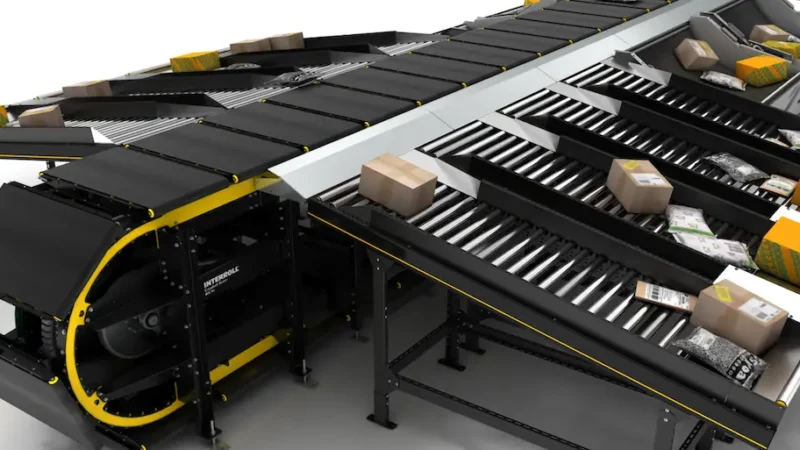
A crossbelt sorter is a continuous loop sorter that uses a dedicated carrier for each item. Mounted on each carrier is a small belt conveyor positioned perpendicular to the main track. As products enter the sorter, barcode scanners or photo eyes identify each item and assign it to a carrier. When the carrier reaches the correct divert point, the belt activates and gently moves the item into the appropriate chute or takeaway lane.
Because the divert action relies on a small independent belt instead of mechanical pressure, the system allows precise product placement and reduces the chance of damage or misalignment. Facilities can choose from horizontal or vertical designs depending on floor space and throughput requirements.
Core advantages of Crossbelt Sorter Systems.
Crossbelt sorters deliver a balance of speed, accuracy, and flexibility for high volume fulfillment environments. Their carrier based design supports precise control, reliable handling of diverse packaging, and scalable system layouts that grow with operational demand.
- High Throughput Sorting – Crossbelt conveyors can support 300 to 600 cartons per minute depending on design and carrier configuration.
- Precision Product Diverting – Each product is controlled by its own carrier belt, which enables accurate placement Into chutes and lanes.
- Handles Mixed Packaging Types – Cartons, totes, polybags, padded envelopes, and small items move reliably through the system.
- Scalable Warehouse Sorting Solutions – Crossbelt systems adapt well to multi-level layouts and future automation growth.
- Quiet and Low Impact Operation – Powered belt discharge reduces noise and protects products.
Industries where Crossbelt Sorters deliver the highest value.
Crossbelt sortation systems excel in operations that require high throughput, precise routing, and reliable performance across mixed product profiles. Their speed and flexibility make them ideal for industries managing complex orders, growing volumes, and automation at scale.
- E-Commerce Fulfillment
- Parcel and Postal Operations
- Third-Party Logistics Providers
- Retail Distribution Centers
- Automated Distribution Systems
Comparing the Crossbelt Sorter to other sortation technology.
A crossbelt sorter differs from other conveyor sortation solutions in several ways. Sliding shoe sorters use diagonal movement to divert cartons and totes. ARB and DARB systems use activated roller technology for gentle handling of irregular items. Narrow belt and pivot wheel sorters serve medium speed applications.
Crossbelt systems excel when precision diverting is required at high speeds across a diverse product mix.
Key considerations before choosing a Crossbelt Sorter.
Selecting the right solution requires aligning system design with operational demands, facility constraints, and long term growth plans. When evaluating a crossbelt sorter, these factors help determine performance, reliability, and how smoothly the system integrates into existing workflows.
- Throughput goals
- Product size and weight range
- Required divert lanes
- Available floor space
- Integration with existing automated sortation systems
- Maintenance resources and personnel
- Scalability and system expansion
- Implementation Insights
Best practices for induction and loading.
Smooth induction is essential for reliable sorting. Products should enter the system evenly with consistent spacing. Consistent singulation and proper feed alignment minimize jams and ensure sort accuracy at high throughput, while adequate accumulation before induction helps maintain steady flow into the crossbelt sorter. Strategic integration of controls and staging conveyors further supports performance and reduces downstream disruptions.
Maintenance requirements
Routine inspection of belts, carriers, and drive components helps prevent downtime. Keeping the track clear and monitoring belt tension ensures optimal performance. Scheduled preventative maintenance and timely replacement of wear components extend system life, maintain sort accuracy, and support reliable operation in high-throughput environments.
Designing for reliability and uptime.
System reliability starts with proper design. This includes layout planning, adequate accumulation before induction, appropriate lane spacing, and thoughtful controls integration. When these elements are engineered together, the sorter operates with fewer interruptions, maintains consistent performance at high speeds, and delivers the uptime modern distribution environments demand.
Why work with AEC?
AEC is a leading sortation conveyor integrator in North and South Carolina, providing design and installation of automated sortation systems – for more than 65 years.
From advanced automated sortation applications to fully integrated solutions, our team engineers conveyor designs that balance performance, space efficiency, and long-term scalability.
This includes integrating crossbelt sortation systems from Interroll in both horizontal and vertical configurations, aligning product flow, throughput goals, and space constraints to deliver automated distribution systems that improve accuracy, efficiency, and long term performance.
Ready to build a sortation strategy that supports speed, accuracy, and long-term growth?
A crossbelt sorter conveyor delivers the speed, precision, and flexibility required in modern distribution environments. Its ability to handle mixed SKU profiles and high-throughput makes it an excellent choice for eCommerce, parcel processing, retail distribution, and 3PL operations.
Facilities evaluating new automated sortation system options can work with AEC to determine whether a crossbelt sorter aligns with their goals and operational requirements.
Talk with an automation specialist about designing a sortation system that meets today’s demands and scales for tomorrow.
For more than six decades, AEC has been a trusted and well established partner for warehousing, manufacturing, and distribution facilities across North and South Carolina, recognized for delivering automated conveyor solutions that meet real operational demands and consistently perform as promised.
Written by AEC Director of Customer Engagement, Josh Hamrick.