
Estimated reading time: 5 minutes
Right-Angle Transfer Modules: Compact 90-Degree Routing for Conveyor Systems
Not every change in product direction requires a full sortation system. In many conveyor layouts, products simply need to move from one line to another at a right angle. These transfers often happen between workstations, accumulation zones, or parallel conveyor lines. When those transitions need to happen smoothly and without product impact, right-angle transfer modules provide a simple and reliable solution for sortation automation.
Right-angle transfer modules are designed to move cartons or totes 90 degrees from one conveyor to another using controlled, powered motion. Instead of pushing or dropping products between conveyors, these modules guide items sideways while maintaining support and stability. This approach helps maintain consistent flow while keeping the conveyor layout compact.
Executive Summary: Right-angle transfer modules provide a compact, reliable solution for moving products 90 degrees without complex divert sections. Using powered rollers or belts, these modules ensure smooth, impact-free transitions between workstations or parallel lines. Ideal for cartons and totes, they prioritize stability and space efficiency. AEC integrates these high-performance assemblies to provide scalable routing and precise product flow, helping facilities optimize layouts without unnecessary complexity.
- What is a right-angle transfer module?
- How do right-angle transfer modules work?
- What are the core advantages of right-angle transfer modules?
- Best use cases for right-angle transfer modules.
- How do right-angle transfers compare to other sortation technologies?
- What should you assess before choosing a right-angle transfer module?
- What are the key implementation insights and best practices for these modules?
- Get started with sortation solutions
What is a right-angle transfer module?
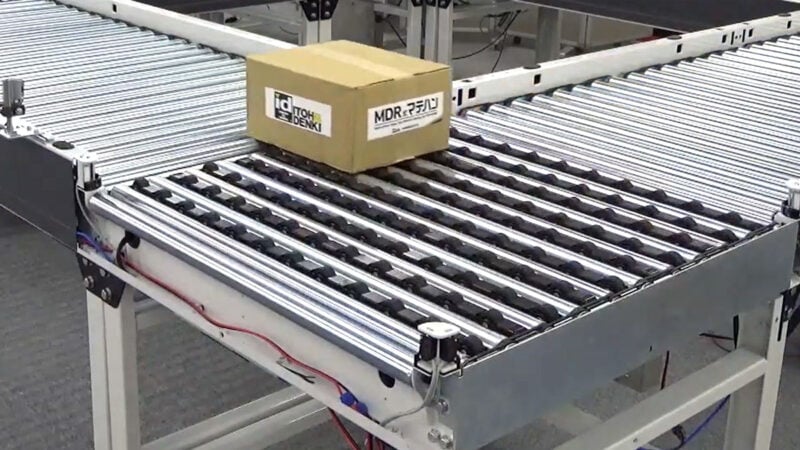
A right-angle transfer module is a compact conveyor component designed to move products from one conveyor line to another at a 90-degree angle. The module sits within a conveyor frame and activates only when a transfer is required.
Many right-angle transfer modules use powered rollers or small belts that rise between standard conveyor rollers. When activated, the transfer mechanism lifts the product slightly and moves it sideways onto the adjacent conveyor. Once the transfer is complete, the mechanism lowers and the main conveyor resumes normal operation.
How do right-angle transfer modules work?
These modules work by using sensors to detect an incoming product, triggering a set of powered rollers or belts to rise, engage the item’s base, and transition it sideways onto an adjacent conveyor.
When activated, the transfer mechanism raises the powered rollers or belts to engage the bottom of the product. These rollers then move the item sideways onto the receiving conveyor. Because the product remains supported during the transfer, movement is controlled and predictable. After the transfer is complete, the mechanism lowers back into the conveyor frame and the next product continues forward.
What are the core advantages of right-angle transfer modules?
The core advantages of right-angle transfer modules include a space-saving compact design, smooth handling that reduces product impact, and the flexibility to integrate into existing layouts without large divert sections.
Right-angle transfer modules provide several practical advantages:
- Compact design
Transfer modules fit into tight spaces without requiring long divert sections. - Smooth product handling
Items are guided sideways rather than pushed, reducing impact. - Flexible layout options
Conveyors can intersect or run parallel without adding extra floor space. - Reliable transfers
Powered rollers maintain consistent product movement between lines. - Simple integration
Modules can be installed within existing conveyor sections.
Best use cases for right-angle transfer modules.
The best use cases for these modules include routing cartons between parallel lines, feeding dedicated packing or inspection stations, and creating tight intersections where floor space is limited.
Right-angle transfer modules are typically used for directional transfers rather than large multi-destination sorting:
- Moving cartons between parallel conveyor lines
- Feeding packing or inspection stations
- Routing products between processing areas
- Creating compact conveyor intersections
- Integrating multiple conveyor systems within a limited footprint
How do right-angle transfers compare to other sortation technologies?
Right-angle transfer modules serve a distinct purpose compared to high-speed sortation conveyors, focusing on precision between two intersecting lines rather than multi-destination routing. While technologies like sliding shoe, crossbelt, and tray sorters are engineered to distribute products to numerous points at high velocities, right-angle transfers prioritize stable, 90-degree movement in a compact footprint.
Compared to push diverters, right-angle transfers provide significantly smoother movement and superior product support by lifting the item rather than shoving it. Additionally, while pivot wheel sorters offer flexible, multi-lane routing at various angles, right-angle transfer modules are the specialized choice for dedicated, reliable transitions within tight conveyor intersections.
What should you assess before choosing a right-angle transfer module?
Before selection, you should assess the dimensions and weight of your products, the condition of the carton’s bottom surface, and the required transfer speed to ensure mechanical compatibility.
Facilities should evaluate:
- Product size and weight
- Bottom surface condition of cartons or totes
- Required transfer speed
- Conveyor height and spacing
- Integration with upstream and downstream conveyors
- Maintenance access
These factors help determine whether a transfer module is the best approach for routing products between conveyor lines.
What are the key implementation insights and best practices for these modules?
Successful implementation of right-angle transfer modules relies on selecting the appropriate technology to match specific throughput and product stability requirements.
Key best practices include utilizing photo-eye sensors to precisely coordinate the transfer timing, while ensuring consistent speed matching and vertical clearance to prevent jams. By utilizing these 90-degree transitions, operations can maximize floor space and enable complex, bidirectional routing without the need for large conveyor curves.
The strategic value of right-angle transfers.
Right-angle transfer modules provide a practical way to move products between intersecting conveyor lines. Their compact design, controlled motion, and simple integration make them a valuable tool for routing cartons and totes within a conveyor system.
For facilities that need reliable 90-degree transfers without adding large divert sections, these modules offer an efficient solution. From simple localized transitions to complex automated systems, AEC leverages decades of expertise to design and integrate high-performance right-angle transfers that ensure seamless product flow across your entire operation.
Get in touch with a conveyor specialist now about sortation solutions that provide dependable control now and flexibility as your operation grows.
Partnering with AEC ensures maximum operational efficiency.
Over 65 years of providing conveyor solutions, AEC continues to be the leading sortation conveyor integrator in North and South Carolina.
AEC designs and integrates right-angle transfer modules using Itoh Denki’s F-RAT series. These modules combine motor-driven rollers with compact transfer assemblies that fit easily into existing conveyor systems. By applying transfer modules where direction changes are required, AEC helps facilities build efficient conveyor layouts without unnecessary complexity.
Written by AEC Director of Customer Engagement, Josh Hamrick